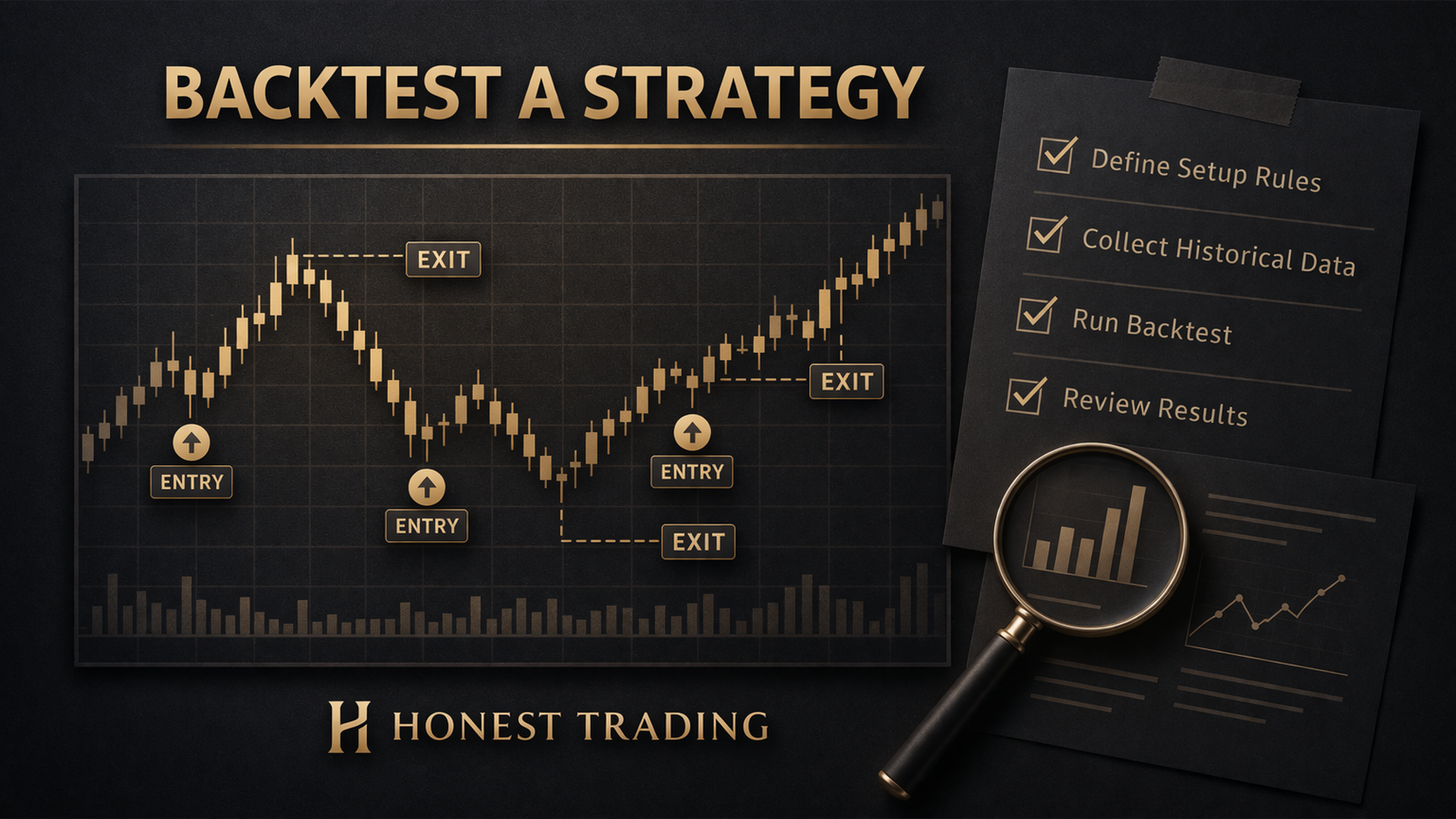
How to Backtest a Trading Strategy
Backtesting a trading strategy means checking how a strategy would have performed on historical market data before risking real money. It is one of the best ways to evaluate whether a trading idea has actual potential or is just another exciting way to donate money to the market.
What is backtesting?
Backtesting is the process of applying a set of trading rules to past market data to see how those rules would have performed. The goal is not to prove that a strategy is perfect. The goal is to find out whether the strategy shows enough consistency, logic, and edge to deserve further testing.
Why backtesting matters
Most trading strategies sound good in theory. Very few survive contact with real market behavior. Backtesting helps traders answer practical questions like:
- Does this setup actually work over time?
- What is the win rate?
- How large are the winners and losers?
- What kind of drawdown should I expect?
- Does this strategy work better in some market conditions than others?
Without backtesting, many traders are basically trading vibes with candles attached.
Step 1: Define your strategy clearly
You cannot backtest a vague idea. A strategy needs rules that are specific enough to follow consistently. That includes:
- entry conditions
- exit conditions
- stop loss placement
- profit target rules
- position sizing
- time filters or market conditions
If your strategy is something like “I enter when the market looks strong,” that is not a backtestable strategy. That is just intuition wearing a fake mustache.
Step 2: Choose the right market and timeframe
Your backtest should match the way you actually want to trade. If you plan to day trade NQ on the 5-minute chart, testing random daily chart data will not tell you much. Use the market, timeframe, and session that reflect your real strategy as closely as possible.
Step 3: Gather historical data
To backtest properly, you need historical price data. Depending on your strategy, this might be daily data, hourly data, 5-minute bars, or even tick data. Better data usually leads to better testing, especially for intraday strategies.
When possible, use clean data that reflects the actual market conditions you care about, including session timing, volatility, and contract behavior.
Step 4: Apply the rules consistently
This is where many traders quietly sabotage themselves. Every trade in the backtest has to follow the same rules. If you keep making little exceptions, changing filters, or “just knowing” which setups to skip, you are no longer backtesting. You are rewriting history to flatter yourself.
Step 5: Track the right metrics
A good backtest is not just about whether the strategy made money. You should track:
- win rate
- average winner
- average loser
- risk-to-reward ratio
- profit factor
- maximum drawdown
- number of trades
- expectancy
A strategy with a high win rate can still be terrible. A strategy with a lower win rate can still be excellent. Context matters more than vanity metrics.
Step 6: Look for patterns, not perfection
The point of a backtest is not to find a strategy that never loses. That does not exist. The point is to find repeatable behavior that suggests an edge. Focus on questions like:
- Does the strategy work across different months?
- Does it break down in certain market conditions?
- Is performance dependent on one lucky stretch?
- Can I realistically execute this in live conditions?
Step 7: Avoid curve fitting
Curve fitting happens when you tweak a strategy over and over until it looks amazing on past data but falls apart in real time. This is one of the most common mistakes in backtesting.
If you optimize every tiny setting until the strategy fits history perfectly, you are usually building a museum piece, not a tradable system.
Step 8: Forward test before going live
Even a strong backtest is not enough by itself. Before risking real money, it helps to forward test the strategy in a simulator or with very small size. This shows whether you can execute it in live conditions without hesitation, slippage confusion, or self-inflicted chaos.
Final thoughts
Learning how to backtest a trading strategy is one of the most useful skills a trader can build. It replaces guesswork with evidence, improves discipline, and helps you stop taking random setups just because they feel exciting.
A good backtest will not guarantee profits. But it can save you from trading a strategy that never had a real edge in the first place, which is already a huge win.
Leave a Reply